
Main Points
- Peter’s Faith: In his courageous trust in Christ’s teaching, Saint Peter stands as the example of right belief (orthodoxy).
- Dynamic Orthodoxy: Peter’s orthodoxy has critical relevance for today. To hold to orthodoxy is not to cling stubbornly to static set of doctrines. Rather, it is to hold fast to what is ancient while actively participating in the work of making it ever new.
- Difficulties are Invitations: Difficulties are the challenges that we have in understanding a particular aspect of the Catholic faith. They are invitations to deeper understanding, which is synergetic with deeper faith.
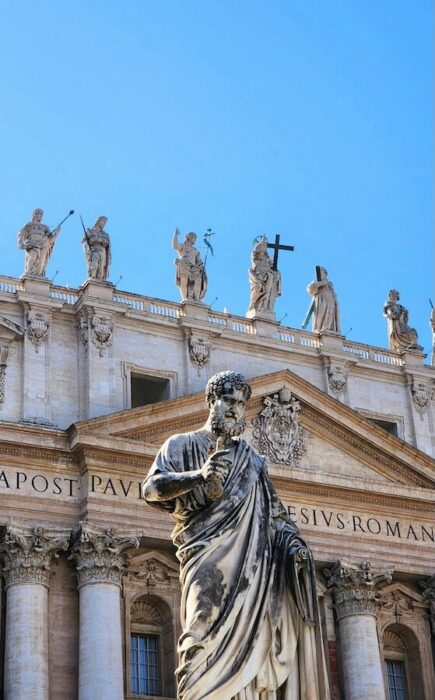
Peter’s Faith
Stated simply, the term orthodoxy (from orthodoxeia) means right belief. When we say someone is orthodox, we mean that his beliefs are aligned with the Catholic Church’s teachings. An orthodox faith does not rest on one’s own theological calculations or private judgments about the truth. Rather, it is marked by a joyful receptivity: a willingness to receive the teachings of the Catholic Church as coming from a divinely given authority.
Orthodoxy is often misunderstood. To shed light on what means, we will begin with two episodes from the life of Saint Peter. The first comes from Matthew 16:13–19:
When Jesus went into the region of Caesarea Philippi he asked his disciples, “Who do people say that the Son of Man is?” They replied, “Some say John the Baptist, others Elijah, still others Jeremiah or one of the prophets. He said to them, “But who do you say that I am?” Simon Peter said in reply, “You are the Messiah, the Son of the living God.” Jesus said to him in reply, “Blessed are you, Simon son of Jonah. For flesh and blood has not revealed this to you, but my heavenly Father. And so I say to you, you are Peter, and upon this rock I will build my church, and the gates of the netherworld shall not prevail against it. I will give you the keys to the kingdom of heaven. Whatever you bind on earth shall be bound in heaven; and whatever you loose on earth shall be loosed in heaven.” [1]
In this passage, Christ affirms Peter’s unique role among the apostles. In response to Jesus’ question, Peter does not merely offer an opinion alongside the others; he proclaims the truth about Christ with a depth and clarity that surpasses them: “You are the Messiah, the Son of the living God.” It is in the wake of this confession that Jesus declares Peter to be the rock upon which He will build His Church, entrusting to him the keys of the kingdom and a share in His own authority. Peter’s proclamation of the truth and his commissioning by Christ are inseparable. He speaks rightly about Jesus, and Jesus, in turn, establishes him as a visible foundation for the unity and faith of the Church.
Yet Christ is careful to clarify the source of Peter’s insight: “flesh and blood has not revealed this to you, but my heavenly Father.” In other words, Peter’s ability to proclaim what is true does not arise from his own brilliance, intuition, and natural reasoning. It is a gift. It is revelation. Christ makes this explicit not only for Peter’s sake, but for the sake of all who would later look to Peter and his successors. The authority given to Peter is not grounded in his personal capacities, but in God’s action through him.
This point is essential for understanding orthodoxy. Throughout the history of the Church, there have been leaders of extraordinary intellectual and spiritual brilliance. Some of our leaders have been morally exemplary. Others haven’t. There have been moments (and even whole pontificates) marked by weakness, failure, and even grave sin. But the apostles did not believe in Peter’s authority because of his personal excellence; indeed, Peter himself would soon deny Christ three times in a single night. Rather, they believed because Christ had made it clear that Peter’s role was divinely ordained. In the same way, Catholics do not adhere to the teachings of the Church because her leaders are always morally exemplary or intellectually superior. We adhere because we believe that the truth proclaimed by the Church does not originate in men, but in God Himself, who continues to guide His Church through imperfect instruments.
So many moments from Peter’s life are recorded in the gospels – moments of great heroism but also moments of failure. Arguably Peter’s greatest moment, and the second story that I wish to highlight today, came when Jesus taught something controversial that threatened to unravel Christ’s public ministry.
The crowds had been asking Jesus for a sign like the manna Moses gave in the desert. In response, Jesus promised a greater food: His own Body and Blood. “Truly, truly, I say to you, unless you eat the flesh of the Son of Man and drink his blood, you have no life in you” (Jn 6:53–54). This teaching proved too much for many to accept. The crowds recoiled: “How can this man give us his flesh to eat?” Even His disciples protested, “This is a hard saying; who can listen to it?” And many of them walked away.
Jesus then turned to the Twelve and asked, “Will you also go away?”
Here, Peter speaks again—but in a very different way than before: “Lord, to whom shall we go? You have the words of eternal life” (John 6:68). Notice what he does not say. He does not claim to understand. He does not pretend the teaching makes sense to him. Peter is likely just as confused as the others. The difference is not that Peter comprehends more. Rather, he trusts more. He remains.
This is orthodoxy in its fullest sense. It is not merely the ability to articulate the truth when it is clear, but the willingness to cling to Christ when it is not. Peter stays not because he has resolved the difficulty, but because he knows the One who speaks. His faith rests not in his own understanding, but in the authority of Jesus and the Church which He has instituted.
And this is precisely the posture demanded of Christians in every age. As St. Paul exhorts Timothy:
I charge you in the presence of God and of Christ Jesus who is to judge the living and the dead, and by his appearing and his kingdom: preach the word, be urgent in season and out of season, convince, rebuke, and exhort, be unfailing in patience and in teaching. For the time is coming when people will not endure sound teaching, but having itching ears they will accumulate for themselves teachers to suit their own likings and will turn away from listening to the truth and wander into myths. As for you, always be steady, endure suffering, do the work of an evangelist, fulfill your ministry (2 Timothy 4:2-5).
Dynamic Orthodoxy
Peter’s fidelity in John 6 and St. Paul’s exhortation to Timothy are not relics of a distant age—they are soberly relevant for our own. Consider that the early Christians lived with a deep reverence for the Eucharist and a corresponding trust in the authority of their bishops. [2] In contrast, many Christians today have drifted from precisely those teachings once held most dear, and, amidst that drift, have also set aside any meaningful sense of a binding teaching authority. The result is a radically different spiritual landscape, one strikingly different from the early Church.
In our time, the Christian is presented with a kind of doctrinal marketplace. There is no shortage of options—indeed, there are thousands. A man who desires to follow Christ is immediately confronted with a bewildering array of denominations, each offering its own interpretation of Scripture and its own account of the Christian life. Many of these communities are led by intelligent, charismatic theologians, making passionate, sophisticated arguments and appealing to a particular view of scripture. And yet, despite this shared appeal to Scripture, they diverge widely—on grace and freedom, on the structure of the Church, on the sacraments, on sexual ethics, and even, at times, on the very nature of Christ, the Trinity, the gospel, and the central dogmas of our Faith. Unlike the early Church, those who profess the name Christian are profoundly fractured at the level of their fundamental beliefs.
This places the ordinary Christian in a difficult position. Take, for example, a new convert seeking to know which brand of Christianity he should choose. In the absence of a recognized teaching authority, he is left to arbitrate between innumerable competing claims. He must decide which doctrines are true, which interpretations of Scripture are sound, and which moral teachings are binding. In effect, he is asked to become his own theologian, his own scripture scholar, his own final court of appeal. Yet Scripture, the very thing on which he seeks to ground his faith, was written across centuries, in multiple ancient languages, within cultural contexts far removed from his own. For this reason, the task is not a simple one. The result is often a never-ending instability—a constant sorting, weighing, and reconsidering in the midst of an ever-expanding field of disagreement. On precisely those issues on which he most needs clarity – moral issues and central doctrines – the contemporary Christian landscape gives him a cacophony of divergent opinions.
The unending disagreement amongst Christian denominations does not only hurt individuals. Among the most disastrous effects of the Protestant splintering is the breakdown of the family. By nature, Protestant churches do not last long. A very small number of “successful” churches have a moment in the sun for a generation or two at best, but most do not last even that long. They all break down. And rifts which begin in the church communities inevitably cause breakdowns in family communities. You might think, for example, of children raised in a particular denomination who, upon reaching adulthood and starting families of their own, find their church or its leadership at an impasse—then comes a bitter church split. In its wake, brother turns against brother, grandchild against grandparent, and confidence in the faith itself is weakened.
A similar instability appears in what is often called the “cafeteria Catholic.” Here, the believer selectively accepts certain teachings while setting others aside, like a person choosing what to eat at a cafeteria. Just like the Protestant, he effectively becomes his own authority. And in some ways, his problem is even more acute: the cafeteria Catholic often retains a vague sense of unity with the Catholic Church while, in reality, keeping her at a distance. He is like a man who seeks help in a hospital but refuses obedience to the doctors proscribed treatments. For this reason, it is not surprising that his experience of religion very quickly becomes cold and lifeless. The appearance of communion and vitality remains for a while, but the substance is weakened, eventually leaving his soul in a quiet and profoundly depressing state of spiritual self-assertion and cultural-religious nicety.
In contrast to the Protestant and cafeteria Catholic, the man who anchors his life and his family in the teaching of the Catholic Church stands on different ground. This is the orthodox man. He entrusts himself not to the shifting conclusions of individual pastors, nor to the fickle witness of frail human leaders. Instead, he grounds his family to the living tradition that claims continuity with the apostles. He believes that Christ established a Church and that Christ Himself continues to guide that Church. He takes Christ at his word that, “The gates of the hell will not prevail against the Church”. Much like Peter, he trusts not so much because he has done the calculations himself, but because he trusts the source of the teaching. His faith, in this sense, is marked by a profound simplicity: he receives what has been handed down. And in doing so, he places his family within a communion that has endured for centuries and, by Christ’s promise, will endure for centuries more.
The faith of the obedient, orthodox Catholic is not easy. At times, even the most ardent believers will be tempted to leave the fold—perhaps a scandal that wounds trust, a teaching that is hard to understand, or a cultural shift that places the Church at odds with the world. In such moments, the believer is faced with a decision not unlike that of Saint Peter: will you also go away? The orthodox man answers as Peter did: “Lord, to whom shall we go?” And so he remains. But we must be clear—his remaining is not passive. He refuses to wander, but he does not stand still.
This is what we might call dynamic orthodoxy. The word “dynamic” comes from the Greek dynamis (δύναμις), which primarily means power, force, or capacity. Dynamic people are characterized by action, or, you might say by movement. The orthodox man does not see difficulty as a threat, but as an invitation to act. When confronted with a challenging teaching or a hostile culture, he does not retreat or selectively edit the faith. Instead, he leans in. In fact, he celebrates the difficulty as an opportunity. He sets himself to the work of understanding more deeply, of articulating more clearly, and of living and/or believing an ancient teaching with vitality. What others experience as a crisis, he receives as a summons—to grow in clarity, in conviction, and ultimately in holiness.
God often permits confusion and even error to gain a temporary foothold so that the truth might, in time, shine more brightly. This pattern is evident throughout the Church’s history: the unchanging doctrines of the Incarnation, the Trinity, the sacraments, the authority of Scripture were all clarified and proclaimed with greater precision after coming under intense pressure through confusion and erroneous individual interpretations. Our own age is no different. Many today leave over the Church’s teachings on sexuality and the family. This is, on one hand, a real loss—leaving many without needed guidance. But it is also an opportunity: a moment for the faithful to rediscover, deepen, and compellingly present the beauty of the God’s revelation. For the truly orthodox Christian, the crises of the age are not occasions for panic, but for zeal. He is dynamic—marked by movement—receiving every challenge as a call to pursue truth, to grow in sanctity, and to press more deeply into the life of God.

Difficulties are Invitations
What are we to do when we encounter something in the Catholic faith that we do not understand? Whether it be the Immaculate Conception, the Real Presence of Christ in the Eucharist, the Church’s teaching on contraception, same-sex marriage, or even more simple teachings like the Christian obligation to love one’s enemies—can we still be faithful disciples while wrestling with such questions?
Here, it is essential to distinguish between difficulties and doubts. A difficulty is an obstacle to understanding. It is the experience of encountering a teaching and thinking, “This is hard. How can this be true?” And yet, even in the midst of that struggle, the believer continues to trust. Like Peter in John 6, he may not grasp the teaching, but he remains: “Lord, to whom shall we go? You have the words of eternal life.” The person struggling with a difficulty who applies his will and intellect to engaging the difficulty, reading, seeking answers, etc., he is a holy man! Difficulties belong to the life of faith; they are not signs of its absence, but often the very means by which it grows.
But as John Henry Newman famously observed, “Ten thousand difficulties do not make one doubt.” Doubt is something different. Doubt is not merely a lack of understanding—it is a refusal of trust. It withholds belief from what God has revealed. It places one’s own judgment above the authority of Christ and the Church He established. In this sense, doubt strikes at the heart of orthodoxy, because it replaces receptivity with self-assertion. Where difficulty says, “I do not yet understand, but I trust,” doubt says, “I will not believe unless I understand.”
Doubts arise for a lot of reasons. Sometimes they arise from a prior laziness in the face of difficulties. When we allow difficulties to sit and fester, they often grow roots which can choke faith. For the dynamically orthodox man, difficulties are not dead ends—they are invitations. They are moments to press in more deeply, to study, to pray, to seek counsel, and to rediscover the richness of the faith.
This is especially true for fathers, who are called not only to believe, but to model belief for their children. A father who engages his difficulties faithfully teaches his children that faith is not fragile. It is alive, resilient, and worth pursuing at every stage of life. When a dynamically orthodox father learns that one of his children has a question about the faith, he does not shut the question down (even if he does not know the answer). Rather, he rejoices in it, treating it as an opportunity to grow in understanding alongside his child and modeling in practice what living faith looks like.
A related danger might be called “doctrinal inflation”—the tendency to elevate one’s own preferences, prudential judgments, or theological opinions to the level of binding Church teaching. Again, this is especially true for fathers. When Dads present their own opinions as doctrine, the result is a subtle but serious distortion: consciences are burdened where the Church has not bound them, and unity is strained by unnecessary divisions. True fidelity requires not only defending what the Church definitively teaches, but also respecting the legitimate freedom she permits.
So the dynamically orthodox man is marked by adventure. He accepts invitations, and he does not falsely present his own opinions as definitive teaching. In this way, for the dynamically orthodox man, the Christian life becomes a continual rediscovery. In his book Orthodoxy, G. K. Chesterton describes a man who sets sail from England, bored with his homeland and eager for adventure. Through a navigational error, he eventually lands again on the shores of England—without realizing it. The sailor lands on a beach in an area of England that he does not recognize, then sets to the task of exploring this new, wild country. [3]
As the voyager unwittingly hikes across the landscape of his native country, his eyes view many of the same sights he saw as a boy. But this time, he sees them differently. He explores his native land with new wonder, as though it were an undiscovered terrain. So it is with the faith. The truths that once seemed familiar—even dull—are encountered anew, with depth and vitality. Engaging our difficulties with a sense invitation and adventure keeps our faith alive.
For Chesterton, not only his faith but also his entire life was most alive when he both (a) lived securely from a place of trust in God’s revelation, and (b) engaged his questions with a spirit of adventure. Faith, then, is not blind acceptance, but a living pursuit of understanding. As Augustine of Hippo put it: “I believe, in order to understand; and I understand, the better to believe.” The dynamically orthodox Christian lives within this movement—rejoicing in questions, seeking understanding, and growing in trust—until what was once difficult becomes a doorway into deeper conviction, deeper trust in the Lord, and deeper love for His Bride, the Church.
Coaching Discussion Questions
- Authority and Trust: How would you explain to the men in your group why orthodoxy depends on trusting Christ’s revelation of truth through the Church—not just your own understanding or judgment? Where do you personally feel that tension?
- Peter as a Model: In both Matthew 16 and John 6, Peter responds differently—once with clarity, once with confusion but trust. Which of those two moments do you relate to more right now, and how might that shape how you lead other men?
- The Modern “Doctrinal Marketplace”: The article describes contemporary Christianity as fractured and unstable. How have you personally seen this confusion affect men or families—and how can your group become a place of clarity and stability?
- Dynamic Orthodoxy in Practice: The article emphasizes that orthodoxy is not passive but dynamic—it leans into difficulty rather than avoiding it. What would it look like, practically, for your group to respond to a hard teaching by “leaning in” instead of pulling back? Can you create a positive, dynamically orthodox culture of men in your small group?
- Difficulties vs. Doubts: Drawing on the distinction echoed by John Henry Newman, the article separates difficulty (“I don’t understand, but I trust”) from doubt (“I won’t believe unless I understand”). How can you create a culture in your group where men feel free to bring difficulties forward without drifting into doubt?
