

You may wonder why we begin these Forge Lead Articles with what we call “Divine Intimacy.” By Divine Intimacy we mean an intentional relationship with the Lord cultivated through prayer. Why start here? The answer is twofold.
First, prayer is the foundation of everything good. Jesus said, “I am the vine, you are the branches. Whoever remains in me and I in him will bear much fruit, because without me you can do nothing.” (John 15:5) If your leadership is not rooted in a daily encounter with Jesus, then no matter how gifted or charismatic you are, you will eventually lead men toward a cult of your own personality rather than toward the Lord.
Second, intimacy with the Lord is a defining mark of mature manhood. At Forge, we encourage men to be manly—robustly, not reductively. A man should learn to provide, to protect, and to cultivate certain secular skills appropriate to his state in life. But these exterior skills alone do not make a man whole. A mature man has also developed the spiritual skills of an interior life—he can pray, repent, listen, and worship. Mature men have an interior relationship with the Lord that they can engage and articulate. They have a language for the movements of their hearts, and they do not perceive such language as an affront to their masculinity. King David, for example, not only slayed giants and led armies; he also wrote psalms. His strength in battle was matched by a heart that knew how to weep, sing, adore, and relate to the Lord.
That is why we begin here. Since you are now a leader in the Forge movement, we start with the highest and most elevated mark of Christian manhood: intimacy with God. Everything else—your fellowship with men, your testimony, your leadership of small groups, your role in rebuilding families—flows from this single source. Divine Intimacy is the most foundational of the habits of any Christian.
Men do not drift into holiness. While it is true that no man can become holy except through God’s grace, holiness still requires human choice. If you want to grow in holiness, there is no more important habit than the habit of consistent, intentional prayer.
Your children—and/or your future children—will almost certainly absorb your habits more than your words. They will imitate your daily routine far more readily than your occasional speeches. If you are a single man, there is no better time to establish a life of prayer than right now; you will never again have as much freedom to build the habits that will one day anchor your home. And if you are already a father, beginning or rebuilding this habit may feel difficult. It will demand a steady, deliberate choice. But it is a choice of enormous consequence.
Karol Wojtyla Sr.

In 1929, a nine-year-old Polish boy named Karol Wojtyła lost his mother. Three years later, he lost his older brother as well. That kind of grief can hollow out a home. But for young Karol, the emptiness was filled—quietly, steadily—by the witness of one man: his father, Karol Wojtyla Sr. In later years, long after he became Pope John Paul II, the younger Karol would point back to those days and say that the deepest formation of his soul happened not in a classroom, not in a monastery, not even in a seminary, but in his home, under the roof of a man, his father, who prayed. [1]
“Day after day,” he recalled, “I was able to observe the austere way in which he lived… After my mother’s death, his life became one of constant prayer. Sometimes I would wake up during the night and find my father on his knees, just as I would always see him kneeling in the parish church.” [2]
This was not pious exaggeration. Friends and neighbors remembered Karol Wojtyła Sr. as a disciplined, almost monastic man. He had served as an officer in the Polish army; he knew hardship and responsibility. But he also knew God. And when his wife died, he did not grow bitter or withdrawn. Instead, he became ever more animated by prayer. His son would see him rise early, kneel at night, and quietly live a life oriented to God.
John Paul II would later become a historic figure in human history. He is by any estimation one of the most important men of the 20th century. His priesthood changed the world, and it all started with his father. Speaking about his dad, John Paul II would later say: “We never spoke about a vocation to the priesthood, but his example was in a way my first seminary—a kind of domestic seminary.” [3]
A domestic seminary. Think about that.
One of the most touching details John Paul II ever revealed was a simple memory: his father taught him a short prayer to the Holy Spirit—nothing elaborate, nothing dramatic. That prayer reads as follows:
Holy Spirit,
I ask You for the gift of Wisdom —
to better know You and Your divine perfections.
I ask You for the gift of Understanding —
to clearly discern the spirit of the mysteries of the holy faith.
I ask You for the gift of Counsel —
that I may live according to the principles of this faith.
I ask You for the gift of Knowledge —
that I may look for counsel in You and always find it in You.
I ask You for the gift of Fortitude —
that no fear or earthly preoccupation would ever separate me from You.
I ask You for the gift of Piety —
that I may always serve Your Majesty with a filial love.
I ask You for the gift of the Fear of the Lord —
that I may dread sin, which offends You, O my God.
Amen.

Just a short invocation. John Paul II would go on to pray that same prayer every day of his adult life, even into his old age. Throughout his speeches and memoirs, John Paul references the simplicity and self-sacrifice which ran throughout his father’s prayer life, specifically his practice of rising early in the morning to prayer. [4]
The witness of Karol Wojtyla Sr. served as a spiritual anchor for the future Pope. If you have been around Forge for any length of time, you know that one of the things which motivates our movement is the importance of fathers in the domestic Church. The witness of a faithful father is critically important for child faith formation. At the center of a father’s faith must be a habit, the habit of relating to God on a daily basis. In short, a father must pray.
The image of the young Karol Wojtyła waking up at night to see his father kneeling on the floor matters. He was watching a sinner doing the one thing every sinner must do: stay close to God. And in the quiet, unseen hours of the morning, a vocation was being shaped—not by pressure, not by persuasion, but by example.
Every man who becomes a father begins, in a mysterious way, to build a seminary inside his home. Not necessarily to raise priests, but to raise souls—sons and daughters who learn what it means to live before God because they have seen their father do it.
John Paul II did not become the man he was by talent or intelligence alone. His courage, tenderness, and spiritual vision all grew out of a boy who watched his father pray—and out of a man who prayed himself.
Tom Monaghan: A CEO on His Knees
John Paul II and his father are famous. But the habit of daily prayer doesn’t only belong to canonized saints and their dads. It can—and must—belong to the working father navigating the trails of today’s world. One modern example is Tom Monaghan, the founder of Domino’s Pizza.
Monaghan grew up poor in Michigan, raised in part by Catholic nuns in an orphanage. That early experience planted the seeds of faith, but as he built his pizza empire into one of the most successful chains in the world, he became consumed by pride, luxury, and ambition. He owned a private jet, a major league baseball team, and one of the largest car collections in the country, including nearly 250 automobiles, many valued at several million dollars apiece.
Then something changed. After reading C.S. Lewis’s Mere Christianity, Monaghan realized his pride had become a spiritual cancer. He began attending daily Mass, making regular confessions, and—crucially—he carved out space every day for silent prayer and adoration. While still CEO of Domino’s, he built a chapel at corporate headquarters and arranged for Mass and adoration of the Blessed Sacrament multiple times a day. Tom’s life began to revolve around prayer. And it wasn’t a fluffy, superficial devotion, either. Monaghan incorporated prayer into the rhythms of daily life—before meetings, during quiet moments, even while washing his hands, turning mundane routines into moments of grace. [5]
Eventually, Monaghan sold Domino’s and gave away most of his wealth, dedicating the rest of his life to Catholic education and evangelization. But his most enduring witness isn’t financial—it’s spiritual. He showed that even a fast-paced corporate CEO can prioritize daily, humble, prayer in the middle of real-world pressure. Affixed atop the chapel at Dominoes headquarters is a sign that reads, “Make time for prayer, then find time for everything else.”
The Quiet Anchor
Karol Wojtyla Sr. and Tom Monaghan couldn’t be more different—one was a retired soldier in rural Poland, the other a billionaire entrepreneur. And yet they shared a single, radical habit: daily, deliberate silence with God. Both were also Dads who certainly struggled to juggle the demands of parenting and marriage, and both had unique struggles specific to their unique circumstances, but both made time for daily prayer.
You need what Karol Wojtyła Sr. and Tom Monaghan had: a decision. A decision that each day will include prayer. A decision that your home will be a place where God is sought. A decision that, however imperfectly, your own life will turn toward heaven—because your holiness is the first gift you offer to those you love.
We live in a moment when many men feel stretched thin, overworked, distracted, anxious, overwhelmed. But this is precisely why daily prayer matters. Prayer is not one more burden to shoulder; it is the lifeline that keeps a man from being crushed by the weight he carries. Before it forms your children, it strengthens you. It orders your heart, clarifies your vocation, and anchors your soul in God.
Moments of distraction, restlessness, or emotional turbulence are not signs that prayer has failed; they are often the clearest signals that prayer is most needed. These are the moments when the lifeline of intimacy must be grasped again—not when it feels natural or consoling, but when it feels costly. Men who prioritize daily prayer, especially when it is difficult, dry, or demanding, do so trusting that intimacy and holiness are forged not by ease, but by persistent and consistent fidelity to daily prayer.
We challenge you to notice what distracts you in prayer. What keeps you from taking time in silence? If it’s always your work, maybe your job has become an idol? If it’s entertainment, maybe you’re too attached to being amused? If it’s sports, maybe that has become more important to you than God?
When a father prays, his home gains direction. His children gain a living model of faith. His wife gains a partner she can trust. And his own soul receives the grace it cannot manufacture on its own. Your children are watching, or one day will be. But even if no one else sees it, God will build something within you the moment you begin.
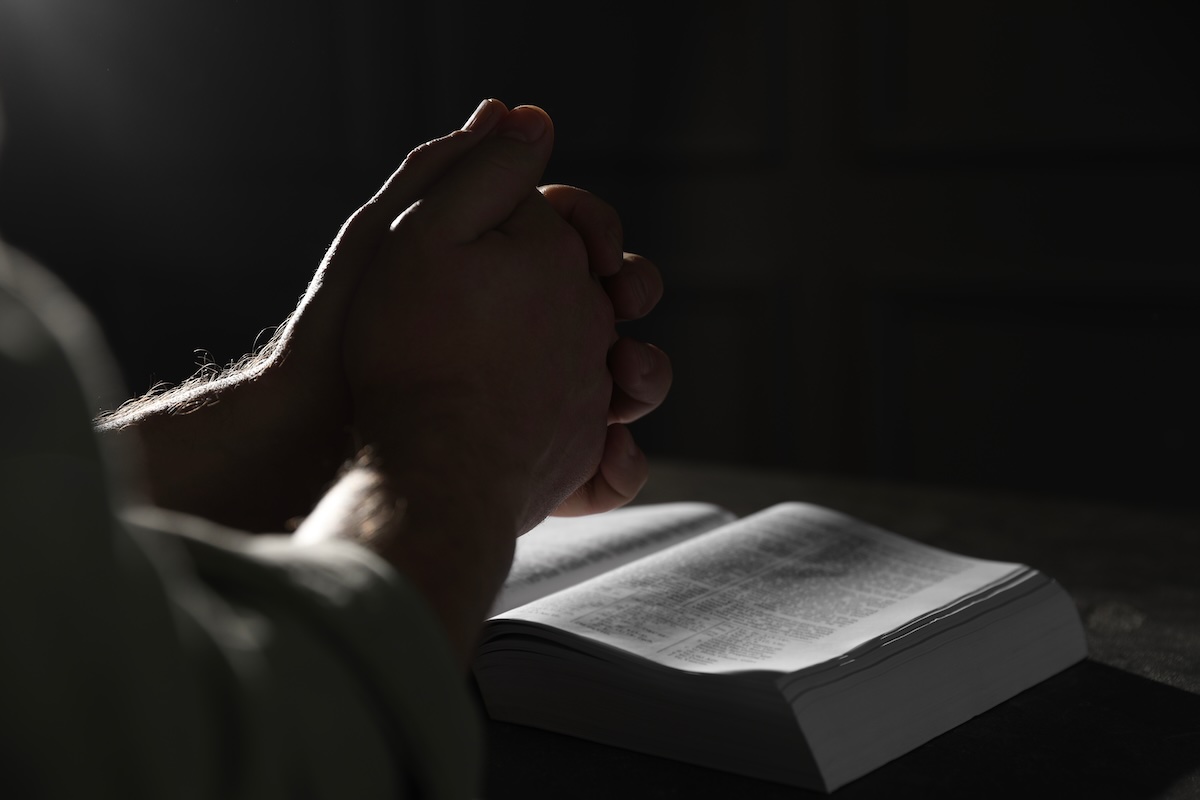
At Forge, we are deeply convinced that every man should carve out daily time for prayer.
If daily prayer has never been a habit for you, now is the time to start. Yes—even if you have twelve kids and a demanding job. Pray.
Sometimes men who are deeply involved with their Church allow that time to replace the daily time to pray. Although, for example, being on the parish council, leading a bible study, serving with the Knights of Columbus, and volunteering with charities are all “good things,” they need to come behind prayer in priority. It would be tragic to spend so much time doing these things for the Lord but not to spend time with HIM!
In his famous book The Soul of the Apostolate, author Dom Chautard says, “It is the life of prayer which gives to all apostolic work its value and its fruitfulness.” [6] At Forge, we take this quote deeply to heart. And it is for this reason, that we ask men at Forge not to lead a Forge group unless they are also willing to spend time in daily prayer.
Your prayer won’t be perfect. Life will throw curveballs, and some days you may miss it. That’s okay. Don’t let the perfect become the enemy of the good. What matters is consistency, not perfection.
As Mother Teresa said, “If you’re too busy to pray, you’re too busy.” If you are not already doing so, our challenge to you is that you set aside a daily time and place to be with God. What does that time look like? Well, we would like to propose three things.
Item #1 – Consistency
Prayer should be regular—it must become habitual. Fathers who commit to daily prayer, even imperfectly, build spiritual depth, resilience, and intimacy with God. Relationships only grow when they are consistently invested in. Prayer is no different. A man may work hard to build a relationship with his wife or child by spending regular time with them; it should be the same with God.
Twenty minutes a day can transform a man over time. We’ll say it one more time – don’t let the perfect be the enemy of the good! Don’t wait until you’re distraction-free or emotionally serene. Just show up. Even a distracted prayer offered in love is better than no prayer at all.
As Saint Josemaría was famous for teaching tens of thousands of layman to pray in the midst of the world, many of whom were husbands and fathers. He taught: it’s not perfection but faithfulness that matters. Even a short daily prayer, offered with consistency, fosters real spiritual growth. [7]
Item #2 – Silence
The Church recognizes many forms of prayer. Of course, the most basic and profound prayer of the Church is the mass. The Church also recognizes and encourages vocal, meditative prayers like the rosary and Divine Mercy Chaplet. These forms of prayer are, of course, staple elements of the Christian life. Nevertheless, alongside the ordinary, vocal prayers encouraged by the Church, we emphatically encourage you to spend time in silence with God.
Why silent prayer? To spend time in regular silent prayer is to create an intentional, interior space to relate to God. In prayer, silence is not just the absence of noise, but an interior quiet that makes room for God. Cardinal Robert Sarah warns against a noisy culture that drowns out the voice of God: “All activity MUST be preceded by an intense life of prayer, contemplation, seeking and listening to God’s will.” [8]
Silence is not emptiness. It is the fullness of presence—God’s presence. The modern father lives in constant motion, bombarded by notifications, obligations, and noise. But evangelization, discipleship, fatherhood, even preaching the Gospel—all of these must flow from silence. This is the center from which everything else springs.
Of course, all of life is in some sense a prayer, but we cannot “pray without ceasing” (1 Thessalonians 5:16) unless we set time aside for devoted prayer. There is an old saying, “You can’t pray all of the time unless you pray some of the time.” The Catechism teaches that prayer is a battle against distraction and superficiality. It says in effect: If you do not set aside specific times to pray, you will not be able to pray ‘at all times’ (cf. CCC 2726–2728). It is not enough to pray ‘on the go.’ You need to stop, be still, and listen.
Set time aside. Fight for silence. Make space in your day to be with the Lord without agenda, without noise, without multitasking. This is where you begin to hear the whisper of grace.
Item #3 – Relational
Finally, prayer must be relational. It is tempting to always take the easier route in prayer—reading a spiritual book, praying a rosary, checking off spiritual tasks. These are good and holy things. But they are not substitutes for a lived relationship with God in prayer.
A husband cannot build intimacy with his wife merely by reading love letters written by someone else, no matter how fervently he reads them. The same is true with God. Sure, someone else may be better at writing beautiful, eloquent prayers, and you should avail yourself of the greatest prayers of the Church. Nevertheless, when it comes right down to it, you must learn to speak plainly to God, and do so regularly.
Prayer must involve vulnerability, listening, and the lifting up of your own joys and sorrows to the Lord. Speak to Him. Tell Him what you’re grateful for, what you fear, where you’ve failed, and what you hope. Then listen. Sit with Him. Be with Him.
The Catechism quotes St. Teresa of Avila saying: “Mental prayer is nothing else than a close sharing between friends; it means taking time frequently to be alone with Him who we know loves us.” [9] This quote is a potent reminder that prayer does not need to be complicated, but it should be real.

A Simple and Powerful Method: Lectio Divina
One of the most time-tested and fruitful ways to begin a habit of prayer is through Lectio Divina, a Latin phrase meaning “divine reading.” This ancient Christian practice invites us to pray with Sacred Scripture, allowing the Word of God to become a living dialogue between the Father and His sons.
Pope Benedict XVI once said: “If [Lectio Divina] is effectively promoted, this practice will bring to the Church—I am convinced of it—a new spiritual springtime.” (10)
The method is simple, but profoundly transformative. It unfolds in four movements:
1. Read
Begin by selecting a short passage of Scripture—just a few verses, like a single story of Christ in the gospels, one of the psalms, etc. Read it slowly and attentively, even out loud if helpful. Don’t rush. Let the words sink in. Pay attention to any word or phrase that seems to draw your attention, then stay with it.
2. Reflect
Read the passage again, this time pausing to ponder the word or phrase that stood out. Why might God be drawing your attention to this? What does it mean—not just abstractly, but personally? Let the passage begin to take root in the context of your own life experience.
3. Respond
Read it a third time, then respond to God in your own words. This is the heart of the conversation. Ask Him what He wants to teach you. We could easily put another word in place here, “relate”. The point at this stage is to actively speak to God about the passage, what it brings to the fore for you, etc. Speak to God about the passage.
4. Rest
Finally, rest. Don’t analyze or speak. Simply be still in God’s presence. This is the stage of quiet communion. The goal here is stillness, playing oneself in a posture of obedience before God, similar to a soldier in obedience before his general. Receive whatever peace, insight, or challenge the Lord gives. Let your soul rest in the gaze of the Father who loves you.
Lectio Divina doesn’t require theological expertise or perfect concentration. It only requires attentiveness, humility, and consistency. Through this simple rhythm of reading, reflecting, responding, and resting, the Word of God can become the daily food that nourishes your soul.
TAKE ACTION
Now that you’ve learned the steps of Lectio Divina, it’s time to put them into practice. Take a few moments to pray with a short passage of Scripture—perhaps the one suggested at the beginning of this article. Follow the four simple steps: Read. Reflect. Respond. Rest.
Next, set a personal goal for daily prayer. Keep it simple. Choose a time and place that you can realistically commit to each day. Don’t aim for perfection—aim for faithfulness.
Here’s a helpful strategy: pray alongside someone who already has a daily prayer habit. That could be your spouse, a friend, or your coach. This kind of shared rhythm provides built-in accountability. In fact, for the first few days, ask them to share how they pray. You’ll grow simply by listening and imitating.
Finally, we want to offer a challenge:
Commit to daily prayer for the next 30 days.
Start small. Stay faithful. Use your coach for accountability, encouragement, and support when you hit roadblocks. And remember: don’t let the perfect be the enemy of the good. God blesses the man who shows up.
Questions for Leads and Coaches
- Do you have an active prayer life at present? What does it look like?
- What is your most consistent excuse not to pray?
- What does this excuse illuminate about your priorities/idols?
- What is your next step to improve your prayer life?
- How can I hold you accountable as you take your next step in your prayer life?
- Discuss the below action items with your coach.
Actions Items:
- Commit to daily prayer. Be specific. See below for tips.
- Commit to weekly Mass. No. Matter. What.
- Commit to monthly Confession (at least). Make it a priority.
- Come prepared to discuss these items with your coach at your next meeting.
Recommended Reading
- Time for God — Jacques Philippe
Perhaps the single best starting point for anyone seeking a quick, accessible, and practical guide to prayer. Clear, encouraging, and immediately useful for men beginning (or rebuilding) a daily prayer life. - The Soul of the Apostolate — Dom Jean-Baptiste Chautard
A classic work on why prayer must be the foundation of all ministry—whether volunteer or full-time. Pope Saint Pius X valued this book so highly that he reportedly read a portion of it every day. - The Power of Silence — Cardinal Robert Sarah
A profound collection of short reflections and aphorisms on the necessity of silence in the modern world. It helps restore a sense of interior stillness that is essential for deep prayer. - The Works of Fr. Timothy Gallagher, OMV
Fr. Gallagher is one of the clearest modern teachers of the spiritual life, especially in the Ignatian tradition. His books and guides on discernment, meditation, and the examen are invaluable tools for anyone seeking growth in prayer.
Appendix for Article #1 – Practical Tips
- From time to time, everyone has days that get away from them for a variety of reasons. Have a “minimum prayer standard” for those days. It can be as simple as taking 5 seconds at multiple times during the day to offer a simple prayer such as, “Thank you Jesus for the gift of this day. Into your hands I commend my spirit.” Or an Our Father. Or a Hail Mary. Or a Glory Be. Every man can commit to a “minimum prayer standard” like this. This can be hugely helpful in fighting off discouragement from not hitting the “normal prayer standard” on a given day or couple of days. Don’t let perfect be the enemy of good, PRAY!
- Have a “normal prayer standard” that targets 20 minutes a day. This is what you will do on most days, and it is what you return to as soon as possible if you have a day or two that you had to default to the minimum.
- Consider having a prayer journal to write down your prayers, or what you discover in Lectio Divina, or what insight or thoughts you have from your prayer time. Some people find this a great way to stay mentally engaged and it can become a wonderful resource to refer to over time.
- Consider setting an alarm on your watch or phone two to three times throughout the day to remind you to stop and reset in prayer – reminding yourself that you work for God, that you are a disciple of Jesus Christ, that you are called to live virtuously, that without Jesus you can do nothing. Offer all you are to God.
- Consider taking either your morning or evening commute (if you work outside your home) to drive in silence and offer up some prayers to God, whether memorized or unscripted.
- Be honest with God. Tell him your fears, your frustrations, your pain…what you think is your cross. Tell him your need for him. Thank him for all the good gifts you have. Our God wants us to be honest with him (he already knows 😊) and to be honest with ourselves. Ask for his grace to be faithful in following him.
- Consider keeping a prayer log (distinct from a journal). For those of you who keep “to do lists” make prayer a top priority and check that box when you’ve done it! But consider keeping a log of your consistency. Hard data can really help us be honest with ourselves on how we are doing.
- Remind yourself of why you are praying. Have a verse or sentence that you can see as you start your prayer time. Some suggestions:
- Without me you can do nothing (John 15:5)
- Every perfect gift is from above, from the Father of lights (James 1:17)
- Unless the Lord build the house they labor in vain who build (Psalms 127:1)
- No disciple is greater than his master. Jesus prayed.
- Seek first the kingdom of God and his righteousness (Matthew 6:33)
- Put your phone, watch, computer, or whatever distracts you out of the way. Put them to sleep, silent, Do Not Disturb or in a drawer or all of the above. Whatever is or might be demanding your attention, give to God at the start. Ask him to take care of it until you are done with prayer, and to guide you when you re-engage in those things. Then focus on your prayer time with God.
